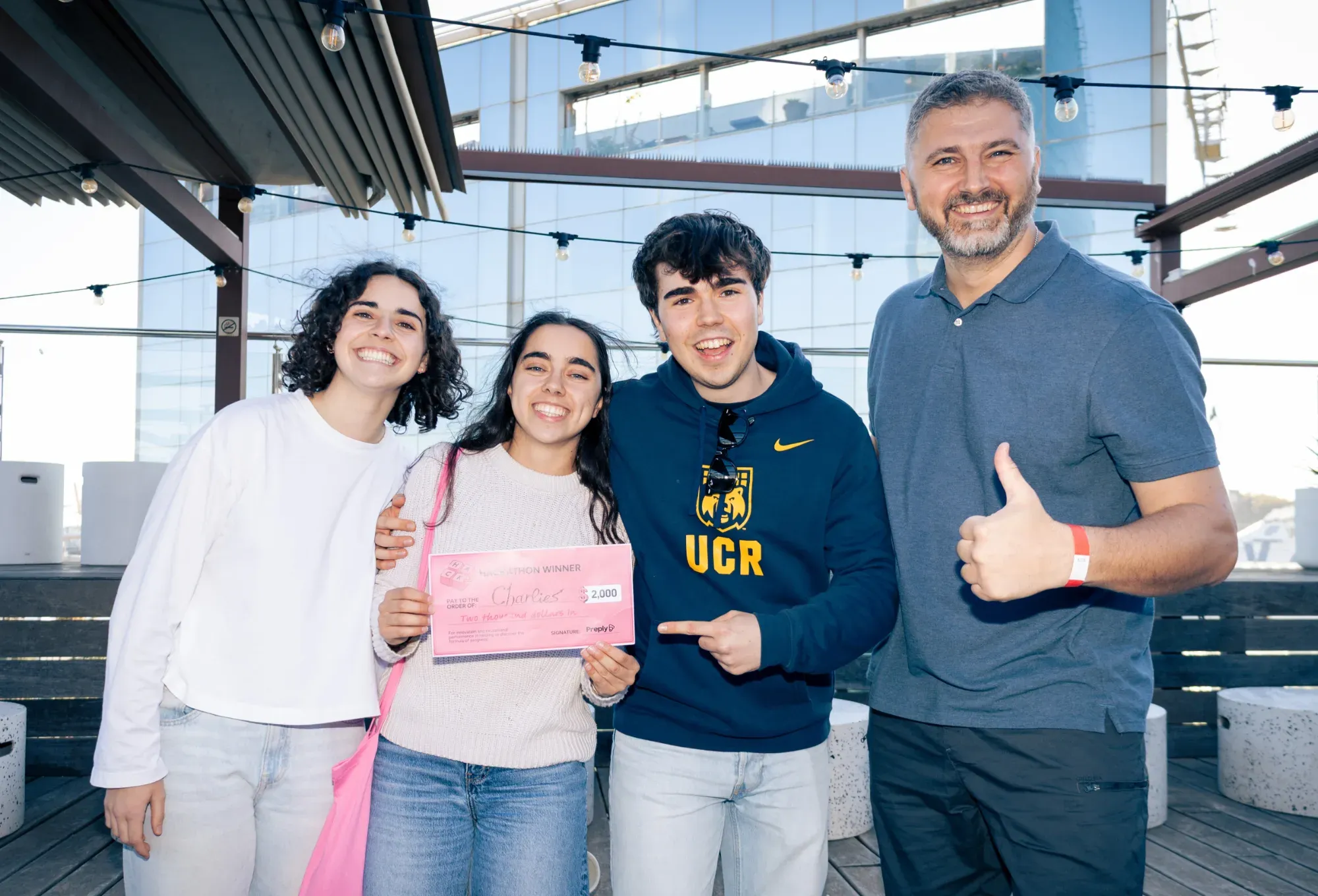
Project Europe Hackathon Winner
NLP to evaluate online language learning progression
With this project my teammates Cristina, Marta and I won the Preply (online language learning platform) track at the hackathon Project Barcelona, organized by Project Europe.
Preply wanted to know how to quantify whether a student was improving given the audio transcriptions from the language lessons.
1. The data we were given
The file containing the transcriptions from the classes had the exact word that was said, when it was said (start and end time), a confidence score (how sure the model is it heard the word correctly),and which speaker said it (channel 0 = the student, channel 1 = the teacher).
Example of data:
{
  "results": {
    "channels": [
      {
        "alternatives": [
          {
            "words": [
              { "word": "hello", "start": 2.32, "end": 2.8,  "confidence": 0.94384766, "punctuated_word": "Hello?" },
              { "word": "fine",  "start": 5.68, "end": 6.08, "confidence": 0.81469727, "punctuated_word": "Fine."  },
              { "word": "thanks","start": 6.72, "end": 7.22, "confidence": 0.97558594, "punctuated_word": "Thanks." }
            ]
          }
        ]
      }
    ]
  }
}
Our first processing step was to reshape it into something structured: split the stream into sentences, and group those sentences into topic-based chunks, each with a human-readable label describing what was being practiced.
2. How we defined progress
We measure progress on three axes: vocabulary, grammar and fluency.
2.1 Vocabulary
We rate the difficulty of every word the student uses on the CEFR scale, from A1 (beginner) to C2 (near-native).
The hard part is that words don't have one fixed level. So instead of a dictionary lookup, the classifier reads each word in context, picks its most likely meaning, and maps that meaning to a CEFR level.
From there we average the content words into a vocabulary level score, and track how it moves across lessons, new words, retention, and overall growth.
2.2 Grammar
Grammar: not just which words, but whether they're combined correctly and with increasing complexity. We measured things like sentence complexity, correct use of tenses, and structures such as the relative clauses the lessons explicitly practice.
2.3 Fluency
Fluency is about how smoothly someone speaks. This is where the timing data becomes valuable. Because every word carries a start and end time, we can (in principle) measure speaking rate, pauses, hesitations and false starts directly from the transcript.
Overall it was a great experience in which I had the opportunity to build overnight with friends and get to know some of the best people in the European ecosystem.
Thanks Kitty and Jade & Preply team!